

There is a version of the fashion industry that the world sees, the collections, the fittings, the finished garments that make clients feel like the best version of themselves. Then there is the version most fashion designers actually live in.
Measurements are written in a notebook that gets misplaced. Orders confirmed over WhatsApp, then buried under 200 other messages by the time a client follows up. Five different apps (one for invoicing, one for scheduling, one for payments) and none of them connected, none of them built with a fashion business in mind.
Here is what that actually looks like day to day:
- A client calls to ask about an order you confirmed three weeks ago, and you have to scroll through your DMs to find it
- A repeat customer comes in for a new piece, and you cannot remember their measurements because the notebook from last season is nowhere to be found
- You are managing your finances across a spreadsheet, a WhatsApp group, and your memory, and you still cannot tell if last month was profitable
Talented people, but broken systems.
That tension is what this article is about. But before we get to what we built, we want to tell you exactly what we kept seeing, because if you run a fashion business, we think you will recognise yourself in this story.
The Fashion Industry Has a Business Problem Nobody Talks About
The fashion industry is growing at a pace that is hard to ignore. The apparel market has grown from $31 billion in 2020 to over $70 billion in 2024, with an expected annual growth rate of nearly 5% through to 2029. Designers are building international clientele, showing at fashion weeks, and creating work that competes on a global stage. The talent is undeniable and the demand is real. But the industry is moving fast.
Check the behind-the-scenes of almost any fashion business (from a solo tailor in Lagos to a mid-sized bespoke brand with a small team), and you will often find something that does not match the ambition on the outside. A business being held together by personal effort, muscle memory, and a level of mental load that no creative should be carrying alone.
This is not a criticism. It is an observation we kept making, over and over again. Most fashion designers came into this industry because they love the craft. The design, the fabric, the fitting, the moment a client sees themselves in something that was made specifically for them. Business operations were never the dream. And so, for a long time, most designers do what works (until it stops working).
The problem is that “what works” always has a ceiling.
Picture a designer with 40 active clients. She is talented, her work speaks for itself, and referrals keep coming. But her measurements are recorded across three different notebooks. One for walk-ins, one for referrals, one that was supposed to be the “official” record but has been missing since a fitting two months ago.
Orders are confirmed over WhatsApp. Payment follow-ups happen over voice notes. Her fabric suppliers are saved under different names on two different phones.
When a client calls to ask when their dress will be ready, she has to search through several WhatsApp conversations to find the original brief, flip through whichever notebook is closest to find the measurements, try to piece together whether the fabric was sourced last week or the week before, and then compose a confident, professional response from five incomplete sources. This happens not once, but multiple times a day. For every active client and every order.
At a certain volume, this stops being manageable and starts becoming the reason growth stalls. She’s failing to scale because she is spending creative energy on things that a proper system should be handling without her.
And she is not alone. This is the reality for the vast majority of fashion designers running real businesses today. And it’s not because they are disorganised, but no one built the right tools for them.
Why We Built Silver Spoon
Silver Spoon is a unified fashion business management platform built specifically for fashion designers, tailors, and cobblers. The word “unified” matters here. Because the problem was never that designers lacked tools, it was that the tools they had were scattered, disconnected, and created more chaos. We bring everything into a single dashboard.
We did not build it because we spotted a market gap on a spreadsheet. We built it because we kept having the same conversation, with different designers, in different cities, and the story was always the same.
A designer doing genuinely impressive work (clients who loved them, a growing reputation, real demand), but whose business backend looked nothing like their front-facing work.
The Instagram page was polished, and the craftsmanship was exceptional. But behind all of that, orders were slipping through the cracks, measurements were being re-taken because the original records could not be found, and the designer had no real visibility into whether their business was actually profitable.
What struck us most was how normalised it had become.
Designers were not distressed about managing orders through DMs, they had just accepted it as how things worked. They were not alarmed that they had no customer database, they had never been shown that one was possible, or necessary. They had built workarounds for every broken process, and those workarounds had become the process.
The more we looked, the more we saw the same pattern playing out across the industry:
- Designers losing repeat clients because the follow-up experience was inconsistent and unprofessional
- Talented tailors unable to expand beyond their immediate location because taking measurements remotely felt impossible
- Growing brands hitting an invisible ceiling because everything still ran through the founder’s head with no system to support a team
And underneath all of it was a single, persistent truth: the fashion industry had modernised in every visible way, but the business infrastructure most designers were working with had barely changed.
The tools available to them were either built for generic small businesses and required heavy adaptation, or they were enterprise-level systems too expensive and complicated to be practical.
Nobody had built something specifically for a fashion designer, a tailor, or a cobbler. Something that understood how their business actually worked (the measurements, the bespoke orders, the client relationships, the ready-to-wear inventory, the digital presence), and brought all of it into one place.
That gap was too important to leave unfilled. So we decided to fill it ourselves.
The Specific Problems Silver Spoon Is Built to Solve
Building a platform is easy to say and hard to do well. So we want to be specific. Not a list of features, but a direct line from the problems we described above to exactly how Silver Spoon addresses them, because that connection is the whole point.
1. Measurements That Live in a Notebook (And Disappear With It)

For most fashion designers, a client’s measurements are only as safe as the notebook they are written in. If the notebook is misplaced, the measurements are gone. If the notebook stays at the shop and the designer is working remotely, the measurements are inaccessible. And if a client who was last seen eighteen months ago walks back in for a new piece, the designer has to hope they can find the right page, or start over entirely.
Silver Spoon solves this at the root. Every client’s measurements are stored digitally, organised by profile, and accessible from any device at any time. No flipping through pages. No re-taking measurements because the record cannot be found.
But we went further than that. One of the hardest limitations fashion designers face is distance, the inability to take on clients who are not physically present. A designer based in Lagos cannot easily serve a client in Abuja or London without solving the measurement problem first.
Silver Spoon’s Smart AI Body Measurement feature makes taking client measurements remotely accurate, fast, and possible without a single in-person fitting. Your client does not need to travel. You do not need to compromise on fit. The location barrier, for the first time, genuinely disappears.
2. Orders Managed Through DMs and Voice Notes
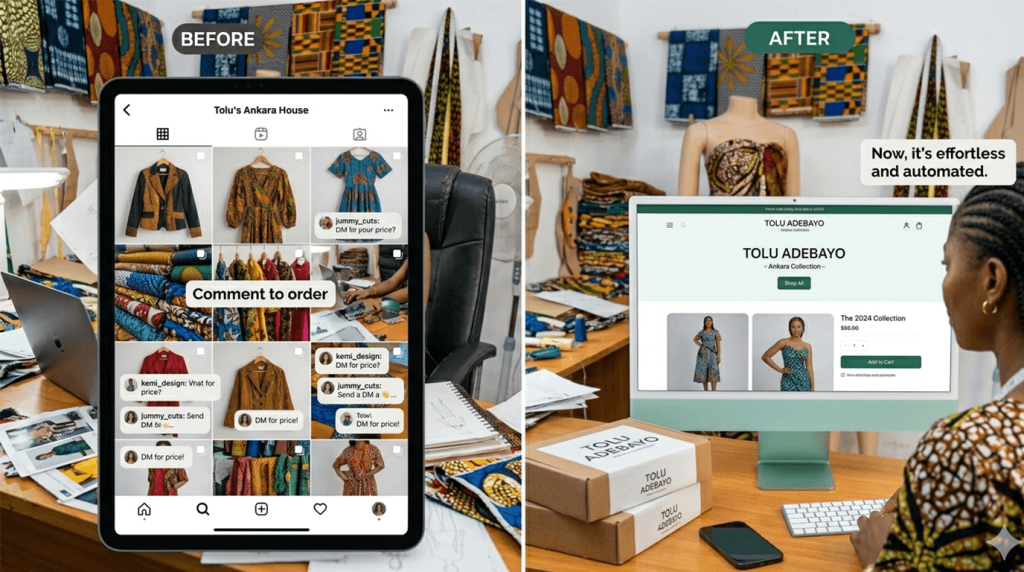
The moment a fashion business starts growing, managing orders through WhatsApp becomes a liability. Messages get buried and details get missed. A client follows up on an order and the fashion designer has to scroll through weeks of conversation to piece together what was agreed. At a certain volume, something will fall through the cracks, and when it does, it is rarely just one order. It is the relationship with the client.
Silver Spoon’s order management system gives every order its own structure. From the initial brief to the final delivery, every detail is tracked and nothing depends on anyone’s memory or inbox.
For designers who want to understand what changes when orders stop living in DMs, managing orders efficiently as a fashion designer becomes a very different experience when there is an actual system behind it.
3. No Record of Who Your Customers Actually Are
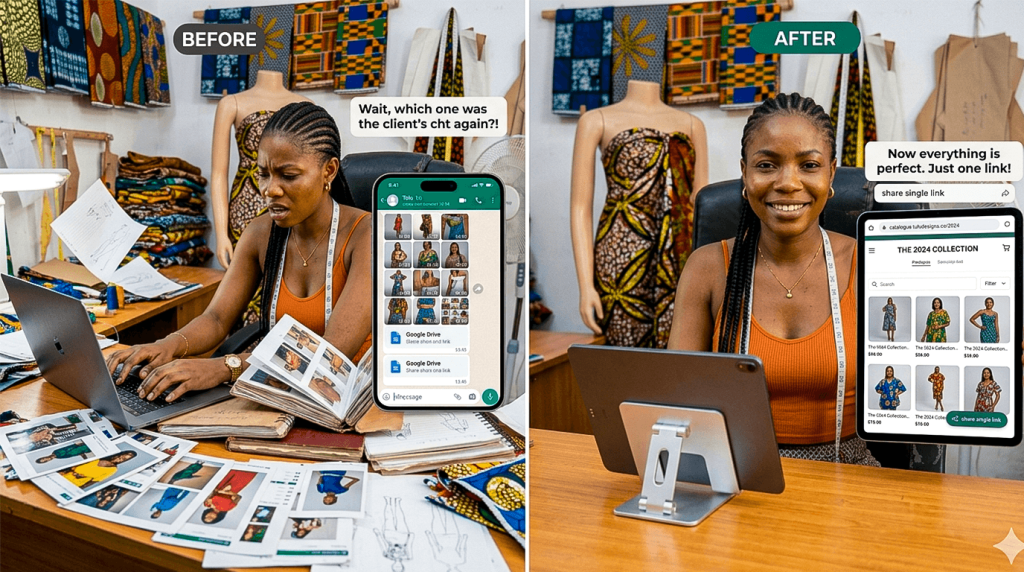
Most fashion designers know their clients. They remember faces, preferences, and personalities because that personal connection is part of what makes the work meaningful. But knowing a client and having a record of a client are two very different things.
Without a customer database, a designer cannot see which clients have not ordered in six months and follow up proactively. They cannot look up the exact measurements, fabric preferences, and order history of a client who just called. They cannot identify their highest-value clients or understand what their repeat business actually looks like.
Silver Spoon gives every client a complete profile (measurements, order history, contact details, notes, and lifetime value), all in one place.
4. No Professional Online Presence Beyond Social Media
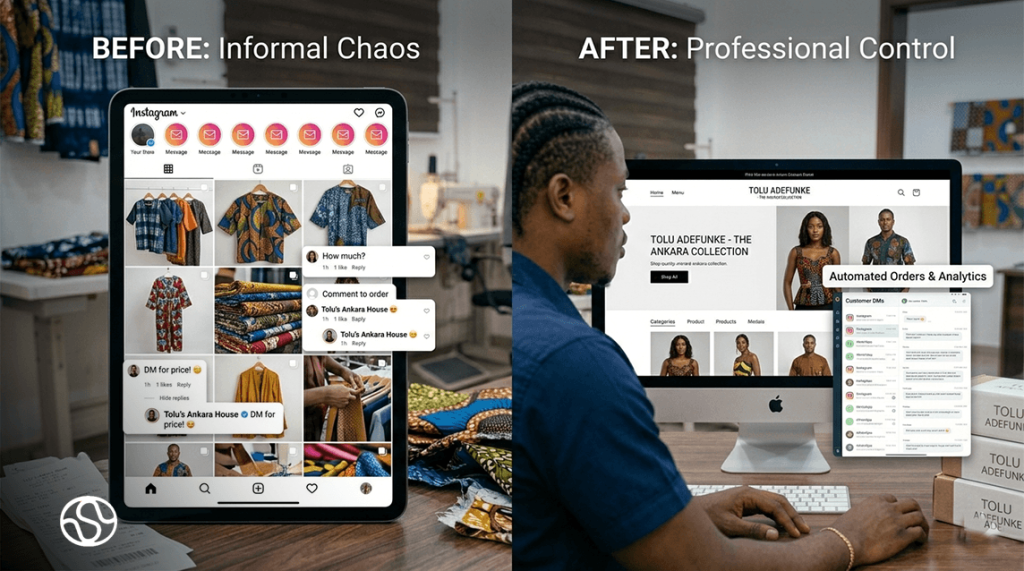
For most fashion designers, Instagram is their website. It is where new clients find them, where their work is showcased, and where orders begin (usually with a DM that says “how much is this?”).
The problem is that Instagram was not built to run a business on. There is no order form, no booking system, no way to present your work in a structured, professional way that builds the kind of credibility that converts a curious visitor into a paying client.
Building a proper website has traditionally felt out of reach for most fashion designers because they think they’re expensive to develop and complicated to manage. So the default has always been to stay on social media and make it work, even when it clearly is not enough.
Silver Spoon changes that. The platform lets designers create a professional, branded business website with their own domain (no coding, no developer, no expensive agency required). It is built into the same platform where their orders, measurements, and client profiles already live.
5. Sharing Your Work Through Scattered Images and WhatsApp Albums
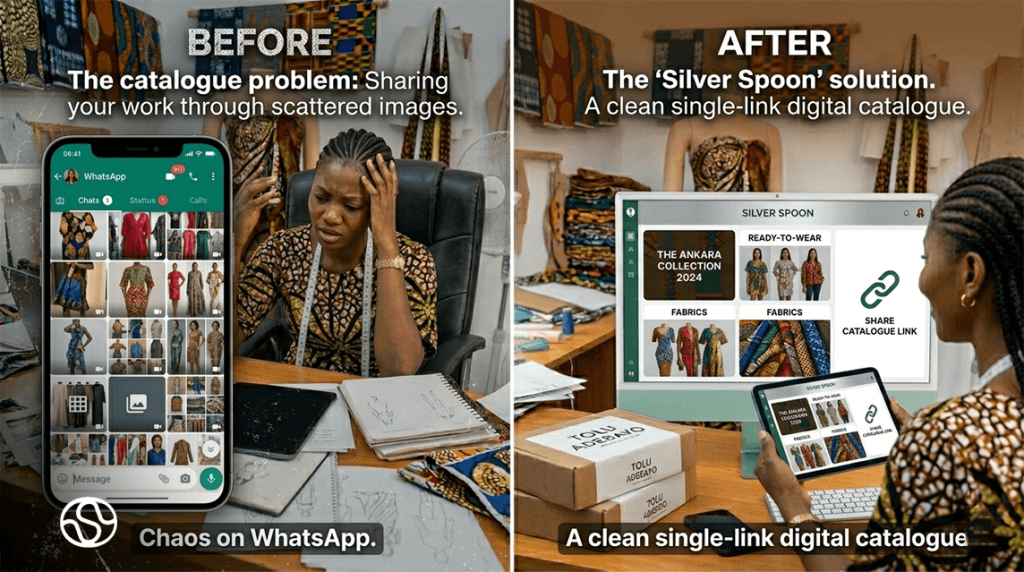
Most fashion designers share their collections the same way. A flood of images sent over WhatsApp, a link to a Google Drive folder, or a screenshot of an Instagram post. It works, until a client cannot find the image they liked, asks you to resend everything, or loses interest somewhere in the back-and-forth.
For a designer whose work deserves to be presented properly, sharing collections through scattered images is doing that work a disservice. Silver Spoon’s Digital Catalogue feature lets designers build a clean, organised showcase of their collection designs and share it with clients through a single link.
Clients can browse, show interest in specific pieces, and initiate an order, all without a single image being sent over DM. It is a small shift in how work is presented, but it changes the entire client experience from informal to professional.
6. Too Many Tools, None of Them Built for Fashion

One of the most exhausting part of running a fashion business without the right infrastructure is the coordination tax. The invisible effort spent making disconnected tools work together. An invoicing app that does not know about your orders. A scheduling tool that does not connect to your client records. A spreadsheet for expenses that has to be updated manually every time something changes.
Silver Spoon removes that entirely. Measurements, orders, customer profiles, inventory, invoicing, expense tracking, a professional business website, shipping, team collaboration, and business analytics, all inside one platform, all connected, all built with a fashion business in mind.
Who Silver Spoon Is For
Silver Spoon is built for fashion designers, tailors, and cobblers, but we want to be specific about what that means in practice, because “built for fashion” can mean a lot of things. The platform is not a generic small business tool with a fashion skin over it. It was designed from scratch with the specific workflows and client relationships of creative fashion businesses in mind.
If you are a solo designer managing everything yourself (the client relationships, the orders, the measurements, the finances, the social media), Silver Spoon is built for you.
One of the most common things we hear from solo designers is that they cannot afford to hire someone to manage operations, but they also cannot afford to keep losing time to disorganisation. Silver Spoon is the system that sits in between doing the operational heavy lifting so that you can stay focused on the work that actually requires your creativity and skill.
If you are running a small or growing brand with a team, Silver Spoon gives everyone the visibility they need to work well together:
- Orders your team can collaborate on and update in real time
- Notes and briefs that do not live in one person’s WhatsApp or head
- Client records and measurement histories that the whole team can access
- A shared structure that makes delegation possible and growth sustainable
- Financial visibility so you always know where the business stands
If you are an established fashion business that has outgrown your current setup, maybe you started with notebooks and WhatsApp and they served you well for a season or two, but the volume of clients and orders has made that approach genuinely unsustainable. Silver Spoon is the consolidation your operations have needed.
Silver Spoon is built for global use. Whether your business is based in Lagos, Accra, Nairobi, London, or anywhere in between, the platform is designed to work for fashion entrepreneurs at every stage, from emerging creatives just starting out to mid-sized brands with teams and inventory to manage.
And regardless of where you are located, why every fashion designer needs more than just DMs to run a professional, scalable operation is a question Silver Spoon is designed to answer.
Conclusion: What Silver Spoon Is Here to Do
We did not build Silver Spoon to add another tool to an already crowded market. We built it because the fashion industry, one of the most creative, culturally rich industries in the world, deserved business infrastructure that actually matched its potential.
Here is what that means in practice:
- Measurements that are never lost — every client’s measurements stored digitally, accessible from anywhere, with the ability to take them remotely using Smart AI Body Measurement technology
- Orders that are tracked from start to finish — no more searching through DMs to find what a client asked for, no more relying on memory to know where an order stands
- Customer profiles that build themselves — a complete record of every client, their history, their preferences, and their value to your business, all in one place
- A professional presence that goes beyond Instagram — a branded business website with your own domain, built inside the same platform where everything else lives
- One platform instead of five — measurements, orders, invoicing, inventory, appointments, team collaboration, expense tracking, and analytics, all connected in one place
The designers, tailors, and cobblers we built this for are not lacking talent or ambition. They are lacking systems. And that is exactly what Silver Spoon is here to provide.
If any of this sounds familiar, Silver Spoon was built for exactly this. Sign up for free, and join fashion business owners who are scaling their business with a tool made specifically for them.
Frequently Asked Questions
Silver Spoon is a unified fashion business management platform built specifically for fashion designers, tailors, and cobblers. It brings measurements, orders, customer profiles, invoicing, inventory, appointments, a business website, and more into one simple dashboard.
Silver Spoon stores every client’s measurements digitally, organised by profile and accessible from any device. And with the Smart AI Body Measurement feature, you can take accurate measurements remotely, no in-person fitting required. For the first time, geography stops being a barrier to who you can serve.
Yes. Silver Spoon was designed to work for a business of one just as effectively as it works for a team. It gives solo designers the structure and visibility of a much larger operation, without needing additional staff to run it.
Yes. Silver Spoon is built for global use. Whether your business is in Lagos, Accra, Nairobi, London, or anywhere else, the platform is designed to support fashion entrepreneurs worldwide.
Most designers currently patch together spreadsheets, WhatsApp, notes apps, and invoicing tools that were never built for fashion and never talk to each other. Silver Spoon replaces that entire stack with one connected platform, so nothing falls through the gaps between disconnected tools.