

You have three client orders sitting in your DMs, two measurement notebooks (one for walk-ins, one for referrals), and a voice note from last Tuesday that you’re fairly sure has Mrs Adeyemi’s deposit confirmation. This is what managing a fashion business without a proper fashion business management platform actually looks like. Everything is living everywhere at once.
Most fashion designers have made this work for years. But the real problem isn’t that the system breaks down, it’s that it quietly holds you back and caps how many clients you can serve, how quickly you can grow, and how professional your business feels to the people paying for it.
This article covers:
- Why manual systems don’t just inconvenience you, but cap how far you can grow
- The specific operational problems a fashion business management platform solves
- Why this matters whether you’re a solo tailor, cobbler, or running a team
- What to look for when choosing the right platform for your fashion business
Running a Fashion Business Without a Platform Is Costing You
Most of the cost is invisible. It doesn’t show up as an item on your expense sheet, it shows up as the client who placed one order and never came back. The referral that didn’t happen. The hour spent scrolling through WhatsApp looking for a fabric note from eight months ago.
Think about what that looks like in practice. A returning client calls to ask about adjusting a piece you made last year. To help her, you need:
- Her measurements
- The original order details
- The fabric and finishing notes
They’re in three different places. A notebook, a chat thread, and possibly a photo you sent to your supplier. Twenty minutes later, you’ve pieced it together. But your client has spent that same twenty minutes wondering whether you really have things under control.
That experience has a cost, and it might not be an immediate one. She might still place the order, but it quietly chips away at the confidence she has in your business. And confidence is what turns a one-time client into a loyal one.
There’s also the cost of orders you simply can’t take. When everything runs through you (your memory, your notebook, your phone), the number of clients you can manage is limited by how much one person can hold in their head.
The right tools change this, and the difference they make to your time and bottom line is more significant than most designers expect.
You can’t delegate what isn’t documented, and you can’t scale what only exists in a WhatsApp thread.
The ceiling isn’t your talent. It’s your system.
Why Fashion Designers Need a Business Management Platform
The issues described above aren’t personality flaws or poor work ethic. They are what happens when a growing business is run on tools that were never designed to work together. A fashion business management platform solves this by bringing every part of your operation into one place, so you spend less time managing information and more time doing the work that actually earns.
Here is where the difference is felt most.
1. Your Measurements Deserve Better Than a Notebook
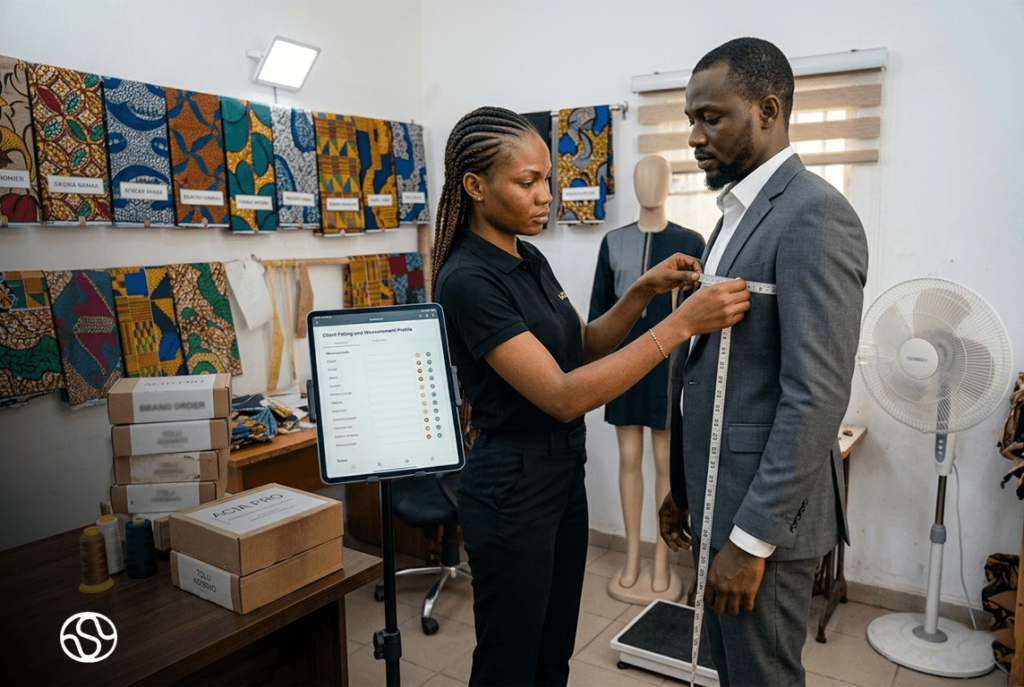
A client’s measurements are the foundation of everything you produce for them. When they live in a notebook, they are one misplaced page away from a costly mistake. Digital measurement storage means every client’s profile is accurate, accessible, and attached to every order you create for them.
And for fashion businesses looking to grow beyond their immediate location, this matters even more. Taking measurements remotely is now possible with AI-powered tools, meaning your client base is no longer limited to whoever can walk through your door.
2. Order Management Shouldn’t Live in Your DMs

An order that lives in a DM thread has no status, no timeline, and no visibility beyond what you can remember. When a client asks for an update, you are scrolling. When a staff member needs to pick it up, they cannot. When something goes wrong, there is no record of what was agreed, when it was agreed, or who is responsible for the next step.
This is not a minor inconvenience, it is a customer experience problem. Clients who feel like their order is not well tracked do not come back. And in a business built on referrals, that loss compounds quietly over time.
Managing orders efficiently as a fashion designer means every order has a clear status, a timeline, a paper trail, and a home that isn’t your inbox. Your clients get better service. Your team, whether that’s one assistant or five, knows exactly where every order stands without having to ask you. And when something needs your attention, you can see it immediately rather than discovering it when it’s already a problem.
3. Your Customer Data Is a Business Asset. Treat It Like One
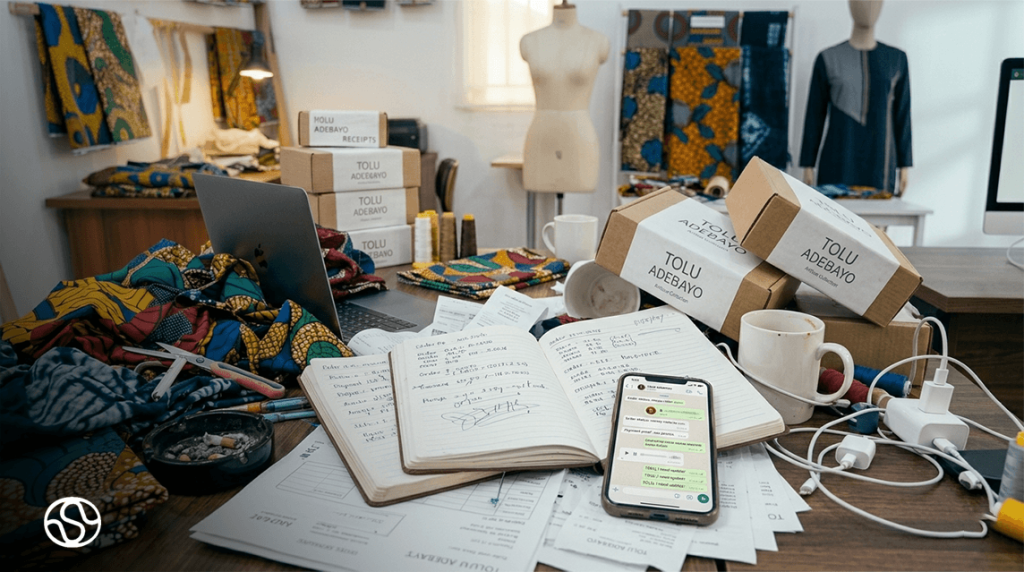
Every client interaction tells you something useful. What they like, what they have ordered before, how their measurements have changed, what occasions they dress for, which fabrics they prefer against their skin. When that information lives in scattered notebooks and chat threads, it disappears the moment the order is complete.
The next time that client returns (three months later, a year later), you are starting from scratch. You ask questions she has already answered, or you piece together her history from memory. She notices. Maybe she doesn’t say anything. But she notices.
Organised client profiles change this entirely. You have context before she even finishes explaining what she wants. That context does three things for your business:
- It makes your service feel personal and professional at the same time
- It reduces the back-and-forth that slows down every new order
- It gives you the information you need to follow up, upsell, and retain the customer
Managing customer profiles effectively is one of the most underrated growth tools in fashion businesses of any size. The designers who do it well don’t just have loyal clients, they have clients who send other clients.
4. You Can’t Grow a Business You Can’t See

If you do not know your revenue this month versus last month, which order types are most profitable, or where your money is actually going, you are making growth decisions in the dark.
Most fashion designers undercharge not because they don’t value their work, but because they have no clear picture of what their work truly costs them.
Think about this. You price a bespoke piece based on what feels right, what the market charges, what the client seems willing to pay. But without tracking your material costs, the hours spent on each order, and your running expenses, you cannot know whether that price is actually making you money. Some of your most popular orders may be your least profitable ones.
And that’s why financial visibility changes how you make decisions, on pricing, on the types of orders you take, on when to hire and when to hold. It tells you:
- Which months are consistently slow so you can plan around them
- Which order types generate the most profit per hour of work
- Where your money is going before it quietly disappears into expenses you stopped noticing
Understanding and acting on this kind of financial data is changing what is possible even for small, independent designers, without requiring a finance background to make sense of it.
5. Ready-to-Wear Needs Its Own System
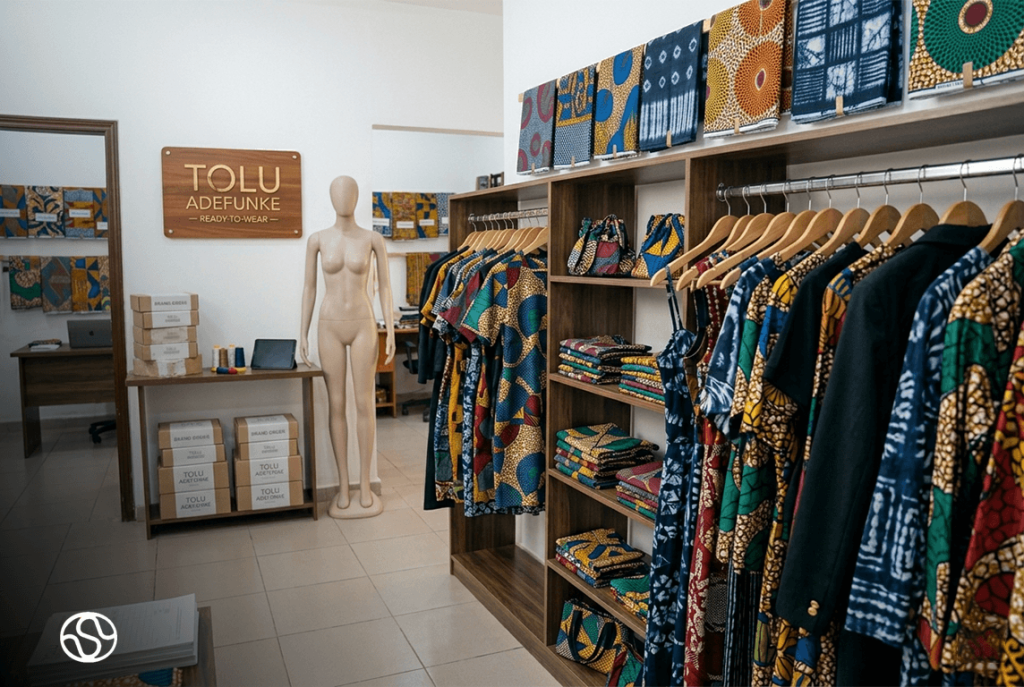
Bespoke and ready-to-wear are two different businesses operating on two different logics. A bespoke order starts with a client. You make what they need, in their size, to their specifications.
Ready-to-wear starts with stock. You produce ahead of demand and sell from what you have. Managing both through the same informal system is where things start to fall apart.
Overselling a size you no longer have in stock. Losing track of what has moved and what is sitting. Failing to reorder materials before you run out mid-production. These are what happens when inventory is managed mentally or on a spreadsheet that nobody updates consistently.
Ready-to-wear also introduces a selling dimension that bespoke doesn’t have in the same way. Your stock needs to be visible, shoppable, and accurately reflected wherever your clients are looking, whether that is your website, your catalogue, or your storefront. When your inventory system and your sales channel are disconnected, the gaps show up at the worst possible moments.
Each of these problems has the same root cause, and it’s not a lack of effort or skill. It’s a lack of the right infrastructure.
That is exactly what a fashion business management platform is built to provide. Here is what it actually looks like when it all comes together.
What a Fashion Business Management Platform Actually Does for You
A fashion business management platform like Silver Spoon is not a generic business tool adapted for fashion. It is built around the specific way fashion businesses operate. Measurement-driven, relationship-dependent, and split between the creative work and the operational work that supports it.
The difference between a platform built for fashion and a general one is that you don’t have to bend your workflow to fit the software. The software already fits your workflow.
When the right platform is in place, here is what changes across every part of your business:
1. Your client measurements are stored digitally: structured, searchable, and attached to every order you create for that client. No more notebooks. No more asking a returning client to come in just so you can re-measure her.
And with AI-powered tools, you can capture accurate measurements remotely, meaning distance is no longer a barrier to taking on new clients.
2. Your orders have a clear home: Every order has a status, a timeline, and a record of every decision made along the way. You can see where everything stands at a glance, and so can anyone on your team.
No more relying on memory or scrolling through chat threads to find out where something is in the process.
3. Your customer profiles hold the full picture: order history, preferences, measurements, and communications. Every time a client returns, you have context. That context is what makes your service feel personal even as your client base grows. It is also what makes follow-ups, repeat orders, and referrals easier to manage without extra effort.
4. Your inventory stays accurate in real time: What is in stock, what has sold, and what needs to be restocked, all of it visible without a manual count or a spreadsheet that nobody remembers to update.
For designers selling ready-to-wear alongside bespoke work, this clarity is the difference between a smooth operation and a constant scramble.
5. Your finances are trackable without a spreadsheet: Revenue, expenses, and business performance are visible in one place, giving you the clarity to make better decisions on pricing, capacity, and growth.
Most fashion designers and cobblers who gain this visibility discover within weeks that they have been undercharging for certain order types because they couldn’t see the full cost picture.
How a fashion business management platform saves you time and money goes deeper into what this visibility makes possible.
6. Your business has a professional online presence: a branded website with your own domain, without the cost of hiring a developer. For designers still taking orders entirely through DMs and Instagram, making the move away from DMs to a professional website and online store is one of the highest-leverage shifts you can make for your business credibility and long-term growth.
Silver Spoon brings all of this into a single, unified dashboard built specifically for fashion designers, tailors, and cobblers.
Rather than stitching together five different tools (none of which understand how your business actually works), everything lives in one place, designed around your workflow from the ground up. And because it is built for fashion specifically, the features you need are already there. You are not adapting a generic tool. You are using something made for exactly what you do.
Is a Fashion Business Management Platform Only for Large Brands?
No. And this is one of the most common misconceptions that keeps small fashion businesses stuck in manual operations longer than they need to be. The assumption is that platforms like this are built for companies with large teams, complex supply chains, and dedicated operations staff.
In reality, the designers who benefit most from getting organised early are the ones who are still small enough that the right systems can shape how they grow, rather than having to fix a broken foundation later.
Think of it this way. A fashion brand with fifty employees has an operations manager, a finance team, and dedicated staff to chase orders and manage clients. A solo designer or a small team has none of that. Which one actually needs a system more?
For example, it has been reported that companies with integrated digital supply chain tools achieved 23% greater profitability than those without. The principle applies at every scale. So, visibility into your numbers is not a luxury reserved for large brands. It is a decision-making tool that any fashion business should have.
The other thing worth saying plainly: the cost of not having a platform is not zero. Every hour spent searching for information, every client lost to a disorganised experience, every order mispriced because the true cost was never tracked, that is the real price of staying manual.
A platform does not add complexity to a small business. It removes the complexity that was already there, hiding in plain sight. Building proper systems in your fashion business is not something you do when you are big enough to afford it. It is what makes getting big enough possible.
Conclusion & Getting Started
The designers who build sustainable, scalable businesses are not necessarily the most talented ones in the room. They are the ones who stopped treating their operations as an afterthought and built the infrastructure their talent deserves.
That infrastructure doesn’t have to be complicated or expensive. It just has to be intentional.
Silver Spoon is a fashion business management platform built specifically for designers, tailors, and cobblers. It brings everything (measurements, orders, inventory, finances, and your business website) into one dashboard, so you can spend less time managing chaos and more time doing the work that actually grows your business.
If you’re ready to start building something that scales, get started on Silver Spoon for free, no credit card needed.
Frequently Asked Questions
A fashion business management platform is a software tool that brings every operational part of a fashion business into one place, including client measurements, order management, customer profiles, inventory, invoicing, and business analytics.
Yes. And starting early is an advantage. Building the right habits and systems from the beginning means you never have to untangle a disorganised operation later. Platforms like Silver Spoon offer a free plan, so there is no financial barrier to getting started.
A general CRM is built to manage customer relationships across industries. A fashion business management platform is built around how fashion businesses specifically operate, with features like digital measurement storage, order tracking tied to client profiles, ready-to-wear inventory management, and tools for remote measurements.
Yes. Platforms like Silver Spoon include Smart AI Body Measurement technology, which allows fashion designers, tailors, and cobblers to capture accurate client measurements digitally, even when the client is not physically present. This removes one of the biggest barriers to growing beyond your immediate location.
It depends on the platform. Silver Spoon offers a free plan to get started, with affordable paid plans available on monthly, quarterly, and yearly subscriptions. There is no credit card required to begin, and you can cancel at any time.